
Follow the actions of the U.S. Army Corps of Engineers

How did the United States Army Corp of Engineer become involved in plans to tear out Junction Falls Dam? Good question!
In 2018, the River Falls Utilities were in the process of relicensing their hydropower project. Junction Falls Dam and Powell Falls Dam. A phase of that process was to eventually remove Powell Falls Dam. Removal of a dam causes changes at the site of the dam, as well as possible unintended consequences downstream. The Utilities contacted the Army Corps for grants to help fund studies.
The Army Corps are a good group of people, and they do good work. But also in the St. Paul Office of the Corps are those who love to fish trout. This group of trout anglers has a primary interest of tearing out Junction Falls Dam to enhance their trout fishing experience. As long as the tax-payer is footing the bill that is.
In 2021, the Army Corps contacted the River Falls Utilities and told them about “Section 206 Continuing Authorities Program” grant available through the Army Corps. Yep, the US Army Corps called us. As one City Council member termed it, money in search of a project. You see, if the Army Corps doesn’t spend the money Congress appropriates to its programs, then the next time around, the funds aren’t appropriated.

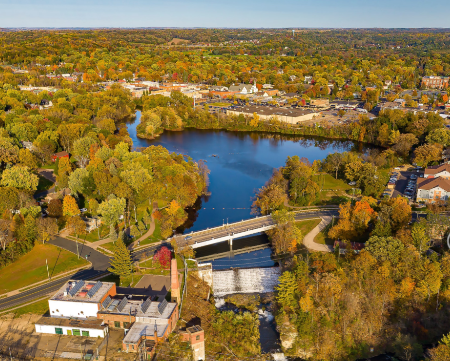
This picture is looking across Lake George at the Winter Street Bridge, the Power Plant building and Junction Falls Dam.
In January 2022, the Utilities formally requested a Federal Interest Determination from the Army Corps. The first step was for the Utilites to agree to pay $325,000 as 50% of a feasibility study. Total cost of the project was estimated at the time to cost $15,000,000. The Army Corps (i.e. YOU the tax payer) would put in $10,00,000 and the River Falls Municipal Utility rate payer (i.e. also YOU as the rate payer) would pay the remaining $5,000,000. (The 2025 price tag is now $15,000,000 Army Corps, $10,000,000 City of River Falls Municipal Rate payers.)
From January 2022 through November 2022, the Army Corps did . . . whatever the Army Corps does . . . and put together three options for the Utilities to consider in the feasibility study. Army Corps’ Nathan Wallerstedt and Jill Bathke presented to the Utility Advisory Board and to the River Falls Common Council their plan alternatives.

This is an itemized list, created by River Falls City staff and presented to the Common Council in obtaining approval of the Army Corps involvement. USACE stands for United States Army Corps of Engineers. CAP stands for Continuing Authorities Program, i.e. the money in search of a project.
Mr. Wallerstadt was clear, all alternatives would be considered and the community would be involved and have a say in the process. Friends of Lake George whole heartedly supported Alternative B. In more detail that alternative would include:
The removal of Powell Falls Dam and subsequent stream and riparian restoration between Powell Falls Dam and Junction Falls Dam. Major components of Alternative B are:
Removal of Powell Falls Dam - including erosion control, clearing and grubbing, access flow management and demolition.
Stream and riparian restoration between Powell Falls Dam and Junction Falls Dam
Excavation, channel stabilization, seeding, plantings, over the 0.5 miles of stream and 15 acres of riparian habitat that once was Lake Louise.
Plan B is much less costly than Plan C and Plan D, whose costs grow incrementally. For an example, not only would Plan C tear out Junction Falls Dam, but would require bridge and infrastructure modifications. That is, Winter Street Bridge was engineered and built after River Falls wholly reconstructed Junction Falls Dam in 1990, just 35 years ago. So the Winter Street Bridge was built with the understanding that it was next to a dam, in a lake environment, which slowed the flow of the river. But now, with a “free flowing Kinni”, especially in flood stage, the physics change. Structural modifications would also have to be made to Veteran’s pedestrian bridge and Maple Street bridge.
Plan D would have to do with all of the above, plus storm water mitigation and modification of the stormwater outflows. It would also require tearing out one or more of our historic downtown buildings. And the costs, both monetary and to the history of our city, continue to add up.
Lake George adds to the character of our downtown River Falls. How many other cities can boast having a lake steps away from Main Street.?
From 2022 through 2024, the Army Corp went about creating its Feasibility Report with Integrated Environmental Assessment. In order for the Army Corps to justify spending $15,000,000 on dam removal, the Army Corps had to meet certain dots on a matrix. Get “more bang for your buck” as it was described. Within their May 2025 draft report, the Army Corps proposed the following (starting on page 53 of the report):
Restoration of two natural waterfall features, “where the Junction Falls and Powell Falls dam currenty reside, achieved through the removal of the dams located on [the falls.] As mentioned, and shown on our Home page, Junction Falls Dam is NOT located on a waterfall.
Create Riffle and Pool Sequences. The purpose of which is to “provide sufficient oxygen to trout eggs and other organisms that may inhabit them.” That is, the Army Corp is not putting the Kinnickinnic back to its original state. But instead, is spending additional tax payer and rate payer money to sufficiently oxygenate trout eggs.
Rock Arch Rapids, Cross Vanes and a Cobble Apron. Again, rather than allow the Kinni to form its movement naturally, the Army Corps would manufacture “steps” formed by rocks and force the Kinni to move unnaturally. Again, all with tax payer and rate payer money.
Lunker Structures. These are described as prefabricated wooden boxes to provide cover for trout.
Stream habitat to provide benefits to trout species.
Spring pond outlet. The final required dot on the Army Corps’ matrix, to get to where they needed to be to qualify for the grant, is the Spring Pond Outlet improvement. You see there is a spring pond, an old trout farm, next to the River Falls Compost site. The Army Corps’ plan includes renovation of this water source.
The River Falls Utility Rate payers will be responsible for 1/3 of these costs, $10,000,000 and anything over the Army Corps grant of $15,000,000. So we have to ask ourselves: How do riffle and pool sequences to provide oxygen for trout eggs, rock arch rapids, cross vanes, cobble aprons, lunker structure and rehabilitation of an abandoned trout farm fishery, have to do with my utility electric bill. Why are the Utility Rate Payers, and for that matter, the Tax Payers, on the hook for an oversized, grandoise, fishing hole?
If you have any questions, do not hesitate to email us at info@FriendsofLakeGeorge.org.
Thank you. We will keep you updated.